
TUZHE PACKAGING GUIDE
Chocolate Gift Box Cavities: Why Piece Count Alone Does Not Define the Insert
Measure each chocolate and cavity separately, then use a sample-fit matrix before approving a custom gift box insert.
On this page
A piece count describes an assortment, but it does not define a chocolate gift box insert. A buyer still needs the maximum envelope of each confection, the usable geometry of each cavity, the relationship between the insert and the outer box, and a physical sample record. Use these checks to turn “12 pieces” or “24 pieces” into a specification that a supplier can review.
Separate the confection from the cavity
Create one record for the product and another for the proposed cavity. For each confection, measure representative physical samples rather than a single ideal piece. Record the maximum length, width and overall height, the intended orientation, the widest point, and any decoration or irregular edge that changes the envelope. If production variation is available, note what was actually measured instead of converting it into an assumed tolerance.
For each cavity, record the opening length and width, minimum usable length and width, usable depth, wall taper, corner shape and any feature that retains or contacts the confection. These are procurement fields, not universal dimensions. No single clearance or standard cavity size applies to every chocolate shape, finish and removal method.
| Record | Field | What to capture |
|---|---|---|
| Confection | Maximum envelope | Length, width and overall height from representative samples |
| Confection | Profile | Orientation, widest point, decoration and irregular edges |
| Cavity | Opening | Opening length and width, including the relevant corner shape |
| Cavity | Usable interior | Minimum usable length and width, depth and wall taper |
| Packed set | Box relationship | Insert position, lid clearance, spacing and removal access |
Keep external L × W × H in its own field
The GS1 Package and Product Measurement Standard provides rules for nominal package dimensions such as height, width and depth. Those trade-item measurements support consistent data exchange, but they do not define the usable shape inside an individual confectionery cavity.
Maintain two blocks in the RFQ. The first records the outer package dimensions using the agreed measurement convention. The second records insert footprint, cavity count and layout, individual cavity geometry, usable depth, spacing and the confection measurements used for the fit decision. A correct outer box dimension is not proof that a particular assortment will fit its insert.
For a related example of product-to-cavity records, compare the macaron insert measurement guide. The fields can be adapted, but the actual values must come from the chocolate and insert under review.
Run a physical sample-fit matrix
CAD can eliminate obvious mismatches, but it does not supply a universal pass value. Load production-representative confections into physical insert samples. Put confection variants on one axis and insert candidates on the other, then record what happened for every combination.
| Confection | Measured envelope | Insert sample | Orientation | Insertion and removal | Movement or damage | Box closes | Decision |
|---|---|---|---|---|---|---|---|
| SKU A | Record actual values | Sample 1 | Record | Observe | Observe | Verify | Pass or revise |
| SKU A | Record actual values | Sample 2 | Record | Observe | Observe | Verify | Pass or revise |
| SKU B | Record actual values | Sample 1 | Record | Observe | Observe | Verify | Pass or revise |
Review in a fixed sequence
- Identify the exact confection and insert revisions used.
- Place each piece in its assigned orientation without forcing it.
- Record whether the widest point clears the opening.
- Observe the seated height, visible compression and presentation.
- Remove the piece using the intended customer access.
- Load the complete assortment and place the insert in the actual box.
- Seat the lid normally and record any contact or closure conflict.
- Repeat with representative product variation where available.
Set project-specific acceptance criteria before the review. One successful fit should remain evidence for that measured combination, not become a universal clearance rule.
Watch for failure modes that piece count hides
- A wider shoulder passes on one piece but catches on another shape in the same assortment.
- The base fits while raised decoration projects above the usable depth.
- A tight cavity retains the piece but makes normal removal awkward.
- Loose positions allow visible rotation or movement during ordinary handling.
- Neighboring pieces interfere because their widest points occur at different heights.
- The insert fits the empty box but rises, bows or conflicts with the lid when loaded.
- A divider or liner is treated as included even though it was never identified in the quotation.
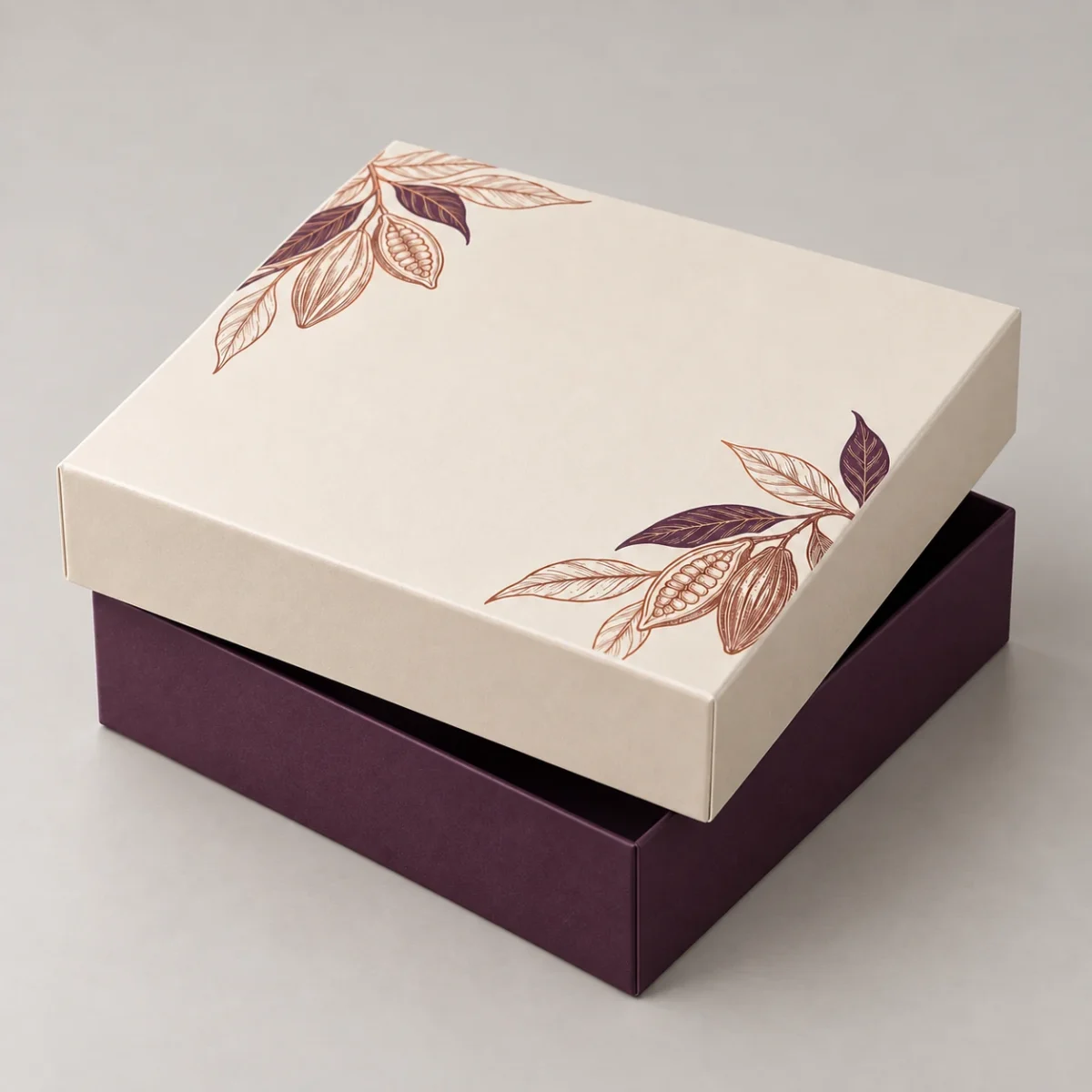
The custom square chocolate gift box concept illustrates a removable-lid format. Its images intentionally do not claim a cavity count or verified insert; the internal arrangement remains a separate project decision.
Keep physical fit and food-contact documentation separate
A sample can show seating, removal, visible interference and closure. Appearance alone cannot establish the regulatory status of a food-contact component. The U.S. Food and Drug Administration explains that food-contact substances include food packaging and its components, and that authorization and conditions of use matter where applicable.
Ask for documentation that applies to the actual insert, liner, coating, adhesive or other contact component and to the intended market and conditions of use. Do not treat a generic material family, a product photograph or a successful fit check as component-specific food-contact evidence.
Validate the complete product-package system
A tabletop fit review and a distribution test answer different questions. ISTA describes packaged-product tests as laboratory simulations selected for the distribution environment and project objectives. Evidence from one tested product-package system should not be presented as a guarantee for an untested confection, insert, box or route.
When distribution evidence is required, define the representative packed system, hazards, conditions, sequence and acceptance criteria with qualified parties. If a material, insert geometry, pack-out or distribution route changes, review whether the earlier evidence still represents the new system.
Send a complete RFQ checklist
- Confection references, shapes, maximum measured envelopes and intended orientation
- Assortment map and piece count, treated as separate fields
- Outer box dimensions and the convention used to state them
- Insert footprint, cavity layout and every usable cavity measurement
- Removal access, visible presentation and loaded lid-clearance criteria
- Every component expected in the quotation
- Applicable food-contact documentation request and intended conditions of use
- Sample quantity, approval steps and revision identifiers
- Distribution environment and any agreed validation requirement
- Artwork, destination and project-specific commercial requirements
Keep the approved drawing, component list, fit matrix, photographs and decision in the packaging sample approval record. Start a project through the custom packaging process only after unresolved geometry and documentation questions are visible in the brief.
FAQ
Does a 12-piece insert have a standard cavity size?
No universal cavity size is established here. Piece count does not specify the individual chocolate envelope, cavity opening, usable depth, taper or removal access.
Can the outer box dimensions be used to approve the insert?
No. External L × W × H and usable internal cavity geometry serve different purposes and should be recorded separately.
Is a close fit always better?
Not automatically. Review retention together with insertion, removal, visible compression, presentation and the behavior of representative product variation.
Does a successful fit check prove food-contact suitability?
No. Fit observations and applicable material or regulatory documentation are separate approval tracks.
Sources and scope
This guide uses the GS1 package measurement framework to distinguish external trade-item dimensions, FDA information to bound food-contact statements, and ISTA information to bound distribution-testing claims. It does not provide universal clearances, food-contact approval for a component, a test result or a supplier capability.