
TUZHE PACKAGING GUIDE
Burger Box Sample Trial: Record Hold Time, Lid Contact and Steam
Document a filled burger-box sample at defined checkpoints so lid contact, closure, visible moisture, liner movement and handling remain comparable.
On this page
A burger box size guide helps choose a carton around the finished menu item. A hold-time sample trial answers a different question: what happens to the closed, filled sample at the checkpoints used by your operation? Record the exact serving, carton and conditions so lid contact, visible moisture, liner movement and handling observations can be compared rather than remembered.
Start after the size decision
First confirm that the carton fits the normal menu configuration and its intended liner. The existing burger box menu-fit guide covers portion dimensions, lid travel and closure clearance. This trial begins after that initial choice. It does not use waiting time to compensate for a lid that already presses on the serving.
Assign one carton reference and revision to the record. Note the relevant menu item, its defined variation, liner, packing sequence and operator. If candidates use different board structures or coatings, identify them by the supplier’s specification; do not infer material from colour or appearance.
Choose checkpoints that match the real service route
Set checkpoints from the operation you actually need to review, such as immediately after closing, after the normal counter wait, and at the end of a representative handoff route. Record the elapsed time at every observation. There is no universal duration in this guide because kitchen flow, menu configuration and customer journey differ.
Keep the sample in the defined position between checkpoints. If it is placed in an outer bag, stacked with another pack or moved through a warmer area, record that condition. A result from one route should not be reported as evidence for an untested route.
Use the same filled serving for every candidate
- Prepare the defined menu configuration using the normal liner and packing method.
- Photograph the serving position before closing.
- Close the lid without pressing the contents into a convenient shape.
- Record whether the lock engages and whether the liner enters the tab or hinge.
- Start the timer at the same operational event for every sample.
- Observe at the preselected checkpoints without repeatedly opening intermediate samples unless that is the stated method.
When opening a box changes the internal condition, use a separate sample for each checkpoint. Record that choice so later reviewers understand why results came from different cartons.
Record lid contact and closure condition
At closing, look through the normal loading route and note any contact between the serving and the inside of the lid. After the checkpoint, photograph the lid interior, hinge and front lock. Record observable facts: a mark at a particular location, a closure gap, a tab that remained engaged or a liner that shifted into the lock. Avoid conclusions such as “too small” until the measurement and packing sequence have also been reviewed.
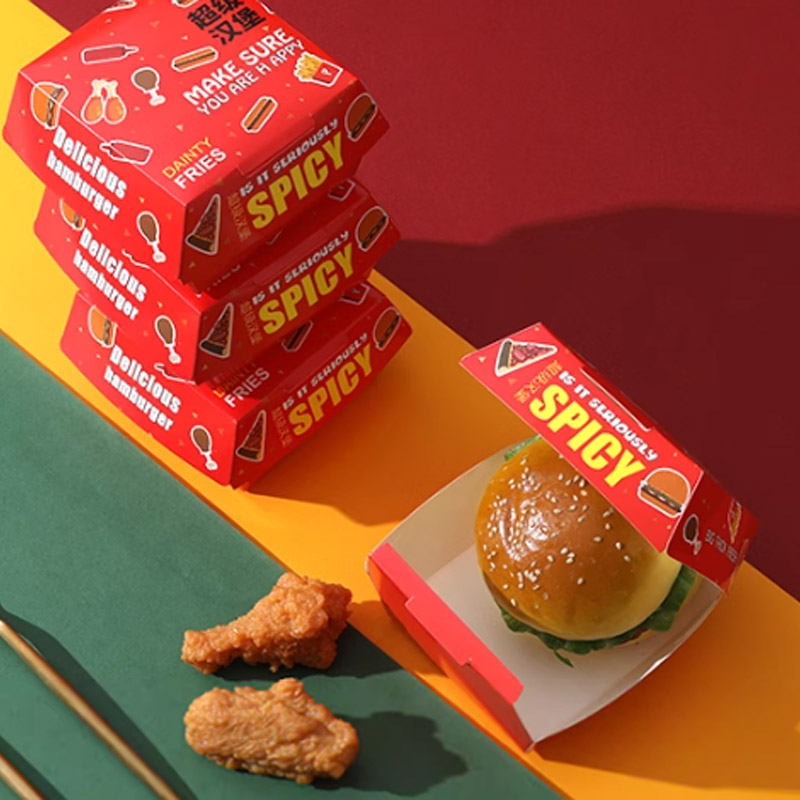
For structure references, compare printed burger boxes with folding closures and printed hamburger clamshell boxes. Photographs show formats; they do not establish dimensions, material specification or performance for your menu.
Describe visible moisture without promising an eating result
Use consistent language for visible droplets, damp areas, surface marking or changes to the carton shape. Identify where the observation appears: lid, sidewall, base, hinge or lock. If the liner moved or folded, record that separately. Do not convert a visual observation into a claim about temperature, food safety, crispness or shelf life.
Note the serving and route conditions alongside the observation. Sauce, oil, a freshly packed hot component, an added cold component and an outer bag can produce different contact conditions. The useful comparison is the defined package system, not an isolated carton photographed without its actual service context.
Check pickup and reopening
| Area | What to record |
|---|---|
| Base | Shape, support and visible marking before and after handling |
| Sidewalls | Bowing, panel movement or interference with the serving |
| Hinge | Opening motion and any liner or food contact |
| Front lock | Engagement, release effort and condition after reopening |
| Liner | Starting position, migration and whether it blocks access |
| Presentation | Observable movement or contact after the defined route |
Lift and place the sample using the normal handoff method. If it travels with fries or another carton, run a separate combined-order check. The filled service routine for takeaway cartons provides related prompts for separating contact conditions from fit.
Keep the operational trial within its evidence boundary
This record supports a buyer’s sample decision; it is not a laboratory performance certificate. ISO 4180:2019 covers general rules for compiling performance test schedules for complete filled transport packages. ISO 2233:2000 addresses conditioning for tests, while ISO 4178:1980 lists information to record for distribution trials. When formal transport performance evidence is required, agree the hazards, conditions, sequence and acceptance criteria with qualified parties.
Turn the result into an approval record
Save the carton revision, menu configuration, component list, operator, route, checkpoint times, photographs and observations. Mark whether the next action is approval, a structure change, a material-specification discussion, another checkpoint or a repeat with corrected packing. Keep sizing, visible-condition and formal-performance decisions in separate fields.
This method gives the query “burger box guide” a practical next step after size selection. It creates evidence for one defined sample and service route without turning a short observation into an unsupported claim about every burger, carton or delivery condition.