
TUZHE PACKAGING GUIDE
Bakery Box Handles: A Loaded Pickup Sample Checklist
Run a repeatable bakery pickup trial that records handle access, closure engagement, balance, deformation and reopening on the exact filled sample.
On this page
An integral paper handle changes how a bakery carton closes, how staff grip it and where the load is transferred during pickup. A neat empty sample can still be awkward after the planned item, board, liner or inner pack is added. Use one repeatable filled trial to separate observable handling issues from assumptions about strength.
Define the exact sample before you lift it
Record the carton reference, revision and component list. Photograph the sample flat and fully assembled. Identify whether the handle is made from two aligned paper panels, a folded lid feature or a separate component. If the pack includes a board, liner, divider or closed inner container, record each item. Do not substitute a different product or change the packing order between candidates.
Describe the representative order without turning it into a universal load rating. The purpose is to compare a known carton with a known packed arrangement. A larger production claim requires an agreed test plan and acceptance criteria.
Assemble the handle in the intended sequence
- Form the body and bottom using the supplier’s stated sequence.
- Fold the side gussets or lid panels without forcing a score in the opposite direction.
- Engage each lock and bring the handle panels together.
- Check whether the grip openings align and whether every layer lies flat.
- Open and close the empty sample once more, recording any tab that catches or releases unintentionally.
Use the repeatable cake box assembly routine if the team needs a fuller flat-to-finished record. Keep the accepted sequence beside the sample rather than relying on memory.
Load the exact pickup arrangement
Place the representative packed item in its final support arrangement. Confirm that nothing rises into the handle folds or prevents a side lock from seating. Close the carton without compressing decoration or pulling a liner into the closure. If the gable or lid must be held in an unusual position while another tab is engaged, record that operator step.
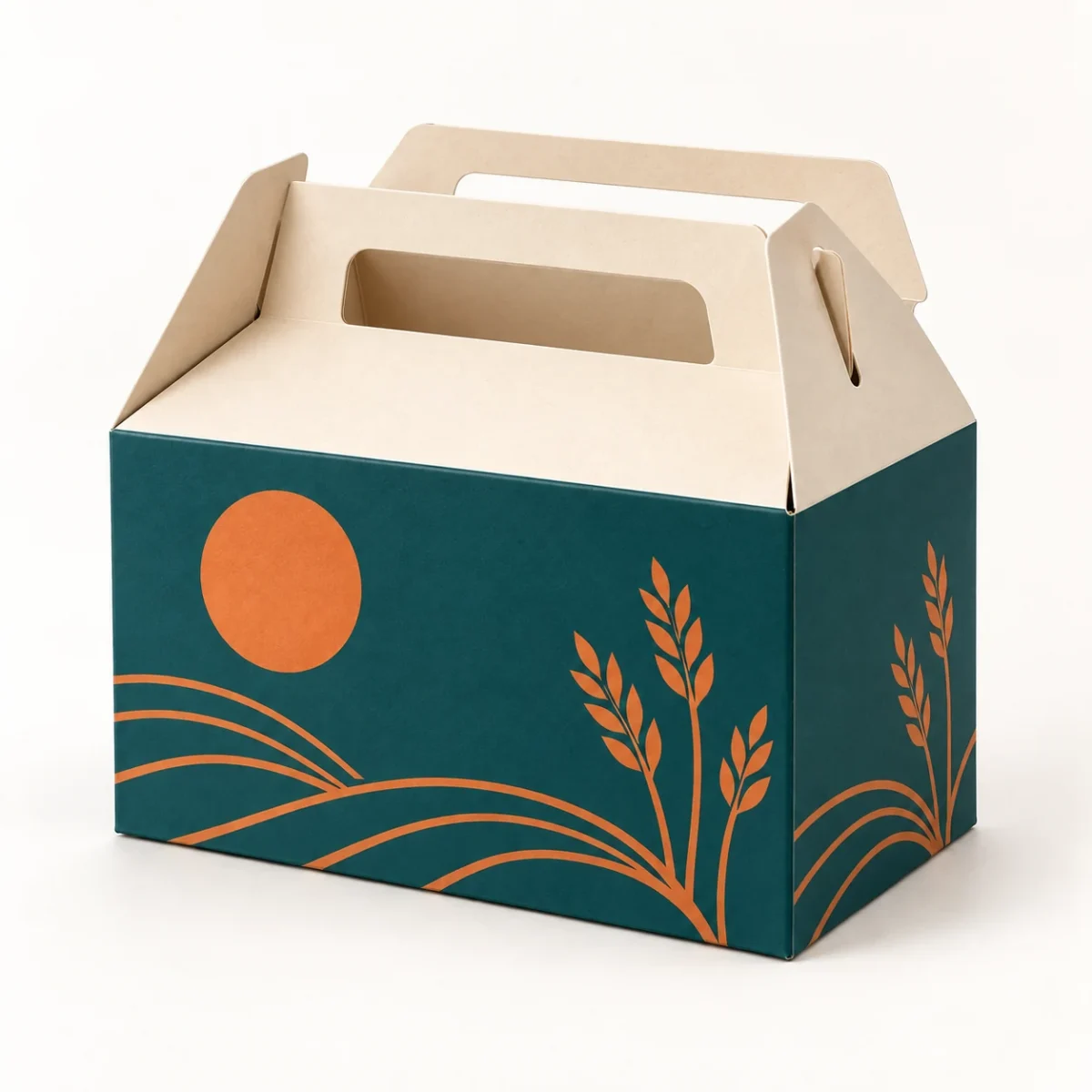
For a wide gable example, review the wide gable bakery carrier concept. For a flatter alternative, compare printed cake boxes with carry handles. The visible format is only a starting point; dimensions and components still need to match the finished order.
Run a short pickup routine
Use the route that staff and customers are expected to follow. Approach the pack from the normal counter side, insert the hand through the grip, lift smoothly, take a short level walk, make the planned turn and place the carton down. Avoid deliberate shocks unless they are part of a separately defined performance test. Repeat with the same operator or record when the operator changes.
Observe the handle during the routine. Is there enough access for the intended grip? Do both handle layers remain aligned? Does the carton tilt because the contents or board are off-centre? Do side locks, lid tabs or the bottom change position? Record facts such as “right handle layer moved upward” or “front lock opened during placement” instead of a vague pass or fail.
Inspect before and after conditions
- Grip opening: record alignment and accessible width before pickup; then inspect edge marking, tearing or a shifted layer.
- Handle folds: confirm the panels start flat and centred; then look for creasing, bowing or separation.
- Side locks: confirm every tab is fully seated; then record movement or release.
- Top closure: record the starting seam and lid position; then inspect for a gap or interference.
- Body and bottom: record the starting shape and support; then note visible deformation or shift.
- Contents: photograph the starting position; then record movement, contact or a presentation change.
Keep photographs from the same angles before and after the trial. If a defect appears, note the exact stage at which it became visible. A change during closing points to a different question from a change after lifting.
Separate a counter check from formal package testing
This checklist is an operational sample review. It does not replace a test schedule for a complete, filled transport package. ISO 4180:2019 establishes general rules for compiling performance test schedules for complete filled transport packages. ISO 2233:2000 addresses conditioning before testing, and ISO 4178:1980 identifies information to record during distribution trials. Use the applicable standards, qualified laboratory and agreed acceptance criteria when formal evidence is required.
Send the supplier a decision record
Return the carton revision, internal dimensions, component list, packed-item description, assembly sequence, trial route, photographs and every observation. Mark each item as accepted, to revise or to retest. If artwork crosses handle folds, slots or overlapping panels, add an assembled artwork proof to the record. This keeps structure, print and handling decisions tied to the same physical version.
A concise, repeatable record makes the next sample useful. It tells the supplier what changed, tells the buyer what was actually reviewed and prevents an empty-carton impression from becoming an unsupported promise about the filled pack.