
TUZHE PACKAGING GUIDE
Brownie Window Boxes: Define the Viewing Zone Before Artwork Approval
Use four closed-pack views to record what remains visible through a brownie box window before approving artwork, portion orientation and revisions.
On this page
A brownie may fit inside a window box while the part a customer sees remains poorly framed. The window opening, printed border and portion orientation create a separate viewing zone. Define that zone before artwork approval so a good structural fit does not hide the texture, decoration or label position you intended to present.
Separate the product footprint from the visible footprint
Start with the complete portion footprint: maximum length, width and height after any liner, board, topping or wrap is added. Then close the sample and trace only the area visible through the window from an ordinary viewing position. That second outline is the visible footprint. It will normally be smaller and may shift as the lid closes.
Do not use the outside window-frame dimensions as the visible area. Paperboard overlap, film attachment, lid angle and wall height can reduce what the viewer sees. Keep the structural fit record in your usual sample approval file; add the viewing-zone record as a separate page.
Record four closed-pack views
| View | What it answers | What to mark |
|---|---|---|
| Straight overhead | Which parts of the portions are visible inside the aperture? | Window edge, portion outline and any hidden band |
| Front counter view | What does a customer see when the box sits on a counter? | Near-wall obstruction, glare and artwork entering the sightline |
| Left diagonal | Does one portion or decoration become obscured? | Nearest contact point and the first lost visual detail |
| Right diagonal | Is the presentation balanced from the opposite side? | Any asymmetry caused by placement or closure |
Use the same distance, lighting and closed-lid position for each revision. A phone photograph is enough when the frame includes the whole carton and the sample reference. Do not crop so tightly that the viewer cannot tell which edge or panel is causing the obstruction.
Test the intended portion orientation
Place the finished portions in the order the packer will use. If two pieces share one continuous cavity, record their orientation and the intended gap between them. Do not add an illustrated divider to the approval record unless a divider is actually part of the proposed construction.
Close the box without rotating or pushing the portions merely to improve the photograph. If a shift occurs during closure, record it as a handling observation. A presentation that depends on an unrepeatable adjustment will be difficult to reproduce during packing.
Keep artwork out of the functional viewing zone
Print around a window can create a useful frame, but a border, wordmark or motif can also compete with the contents. On the artwork proof, show the cut line, the transparent opening and a conservative no-critical-art area. Keep required information, small type and registration-sensitive details away from folds, locks and the window edge.
Check both an empty sample and a filled sample. The empty view helps reviewers inspect the window and printed frame; the filled view shows whether the chosen content orientation still works. Neither view proves the window film, board grade or food-contact status. Those require separate specifications and supplier evidence.
Use a revision table instead of subjective comments
Replace comments such as “show more brownie” with a record another reviewer can act on:
| Field | Example entry format |
|---|---|
| Sample and artwork revision | Physical sample code plus dated PDF revision |
| Contents configuration | Count, finished dimensions, liner and orientation |
| Hidden area | Which edge hides which product detail in which view |
| Requested change | Artwork move, portion reorientation or a construction question |
| Retest needed | Yes, with the exact configuration to repeat |
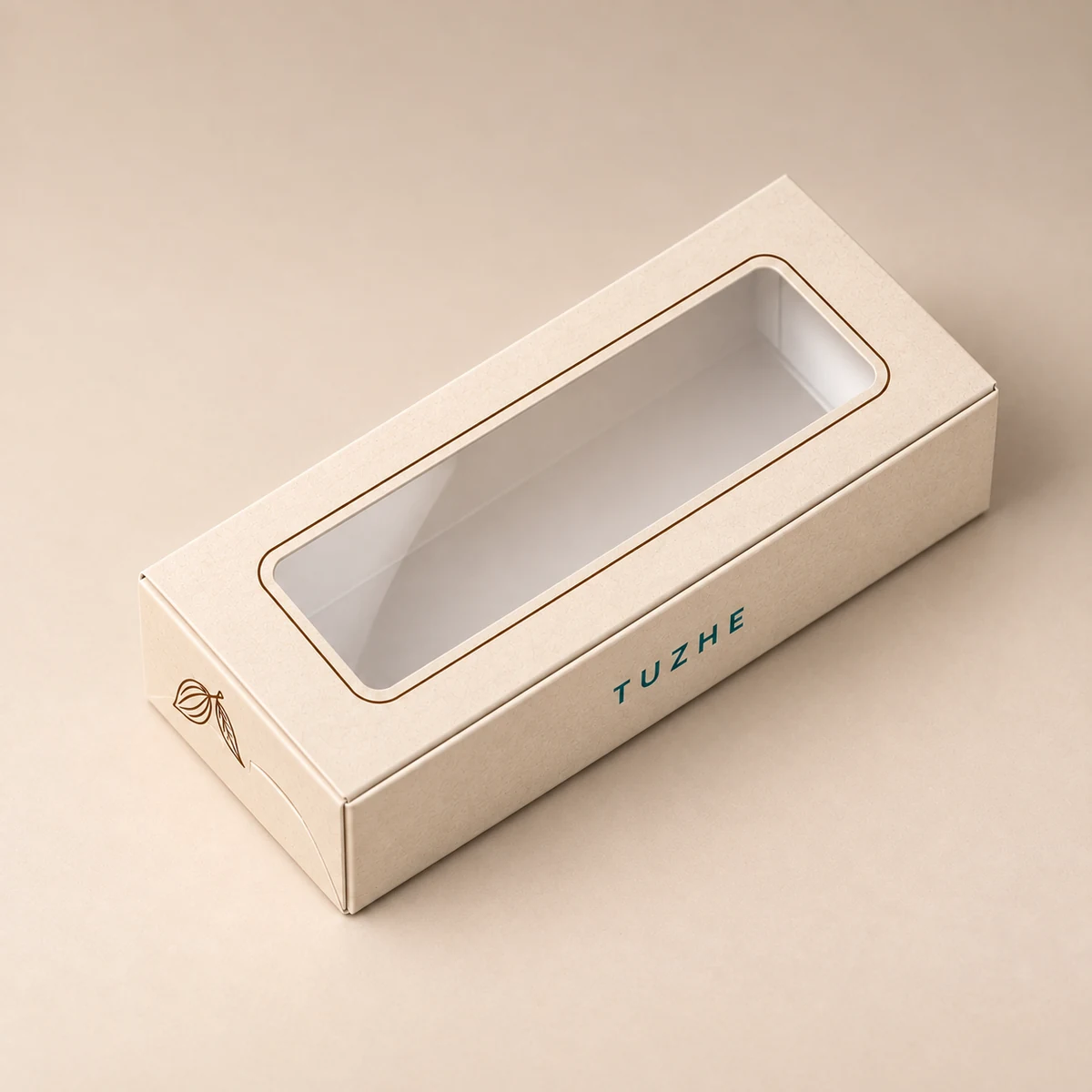
A supplier page for a two-piece brownie window box illustrates the common market premise of presenting compact portions through a long top window. Treat its capacity and dimensions as that supplier’s information. Your own filled-sample record must establish what remains visible in your proposed carton.
Viewing-zone approval checklist
- Use finished portions, including liners, toppings and wraps.
- Photograph the same closed sample from overhead, front, left and right.
- Mark the true visible area rather than the outside window-frame size.
- Record portion orientation and any movement during closure.
- Keep critical artwork and required information clear of the window edge and folds.
- Separate presentation approval from material, fit and food-contact evidence.
- Repeat the four views after any window, artwork or layout change.
Use the shallow brownie window carton concept to discuss the structure, then compare other window bakery box formats. Send the marked photographs, portion details and revision table through the custom packaging process so the quotation and sample request refer to the same review configuration.